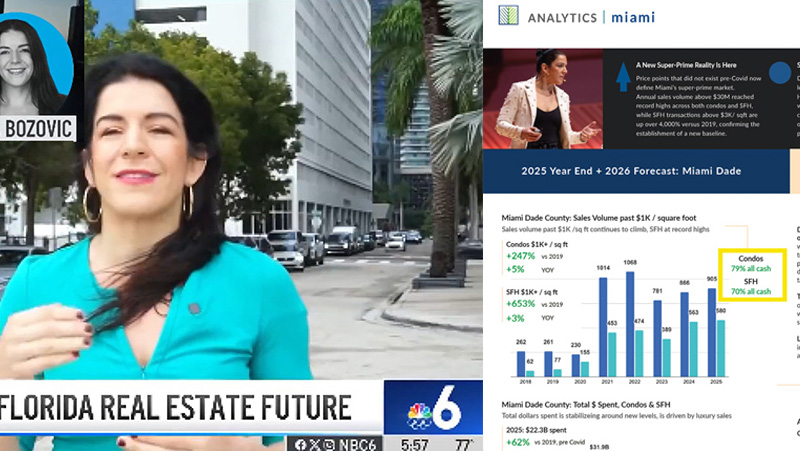
Feb 2026 General Market Update • Market Opportunities • Billion Dollar Miami Tour With Cristiano Piquet • Ana on Jay Roberts The Long Game General market update, February 2026: Miami Dade median SFH price: $685K, up 5% year-over-year Miami Dade median Condo price: $415K, down 8% year-over-year Condos built post 2010, median price: $715K, up 15% year-over-year, and at an all time high. This illustrates the divide in performance between new and old condo inventory. Given that Miami now has the highest concentration of millionaires in the nation, we can expect a to see ongoing market divergence. Segmentation is critical.
Whats the matter with Miami? Sorry WSJ & Krugman, what’s the matter with NYC & LA?
"What's the matter with Miami?" asked Paul Krugman, shortly after the WSJ published a piece with the rather ominous title "Miami Sees Its First Population Drop in Decades".
Well I would put forth a different question:
What's the matter with NYC and LA?
Because while Miami's population bounced back to net positive in 2021-2022, NYC and LA remained negative
The real headline should have been:
Miami population back to positive, as NYC and LA remain negative.
Interesting, isn't it, how the WSJ article implies that what happened in Miami during peak Covid was somehow unique, alarming and foreboding. It was none of the three.
News outlets all over the country ran with this premise.
Amazingly, no one checked the source. The original WSJ article uses one source for its data: A Brookings Institute analysis of census data. The Brookings Institute makes this analysis available to the public for free, includes lots of charts and includes raw data one can download.
I dug deep into the Brookings Institute report and the main points are as follows:
-> Of the 38 counties tracked (with populations over 500K), all but 4 had negative population growth during peak Covid 2020 - 2021. So Miami was hardly unique.
-> Post Covid, 11 counties went back to positive population growth. Miami Dade was one of them, LA county was not.
-> On a city level, Miami followed the same pattern and went back to positive growth in 2021-2022.
NYC did not.
Miami-Dade was very much a part of a national pattern.
Domestically, people were moving out of cities and to the suburbs (during peak Covid). AND international travel was shut down, entirely at times.
So why are we surprised that we had the first population drop since 1970? We had a global pandemic & closed borders.
We had a pandemic with people leaving dense areas AND borders closed to varying degrees. The whole country was affected, and Miami-Dade did not perform worse than the nation.
What is significant is what happened after the peak Covid years, in 2021-22.
The Brookings report mentions multiple times that Miami-Dade and Miami have reversed course and are part the small set that is back to growth.
The WSJ article ignores this entirely.
I think this is sour grapes.
The average salary of a New York filer moving to Miami Dade in 2020 aS $671K. The total was 8,841 filers.
Average salary of the 3,644 filers from Manhattan moving to Miami Dade in 2020: $1.2M.
This is money walking.
Remember, the economic of center of gravity in the nation has just shifted (for the first time) away from the Washington - NYC - Boston corridor.
Momentum cycles are real, and this one has just begun.💸🌴🚀


MiamiDealSheet.com - now live
The best deals in Miami
Powered by Analytics Miami, hand-picked by Ana
Reports, interviews & feature spotlights
Get on Ana’s List
I personally work with a select number of buyers every month.

Related Posts